
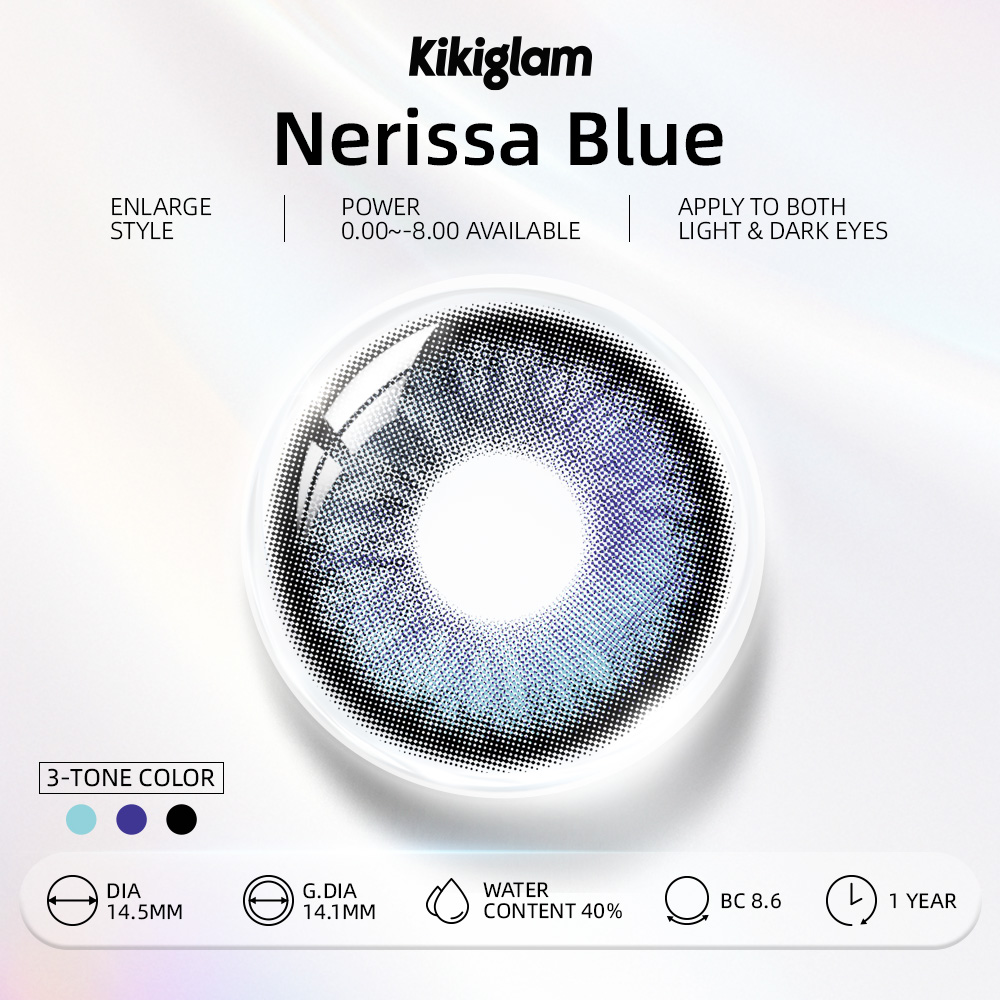
Some blues chase the sky, and some behave like water — light passes through them instead of bouncing off. Nerissa Blue is the second kind, a shade named for sea-nymph light on the waves: a three-tone print that stacks an icy blue field and a violet-shadowed mid-ring inside a firm dark limbal line, over a warm amber core that keeps the center of the eye alive. The card registers it as an enlarge-style lens — 14.5mm diameter with a 14.1mm printed area, 40% water content, an 8.6 base curve, plano through -8.00 power, and a one-year wear cycle per pair at $5.99. This piece reads the shade the way the eye actually meets it: from the full-face impression, down to the ring structure, and finally into the dot-level print.
Shop the 2pcs Kikiglam Nerissa Blue | 1-Year Contact Lenses ($5.99) for $5.99 with free shipping over $20.
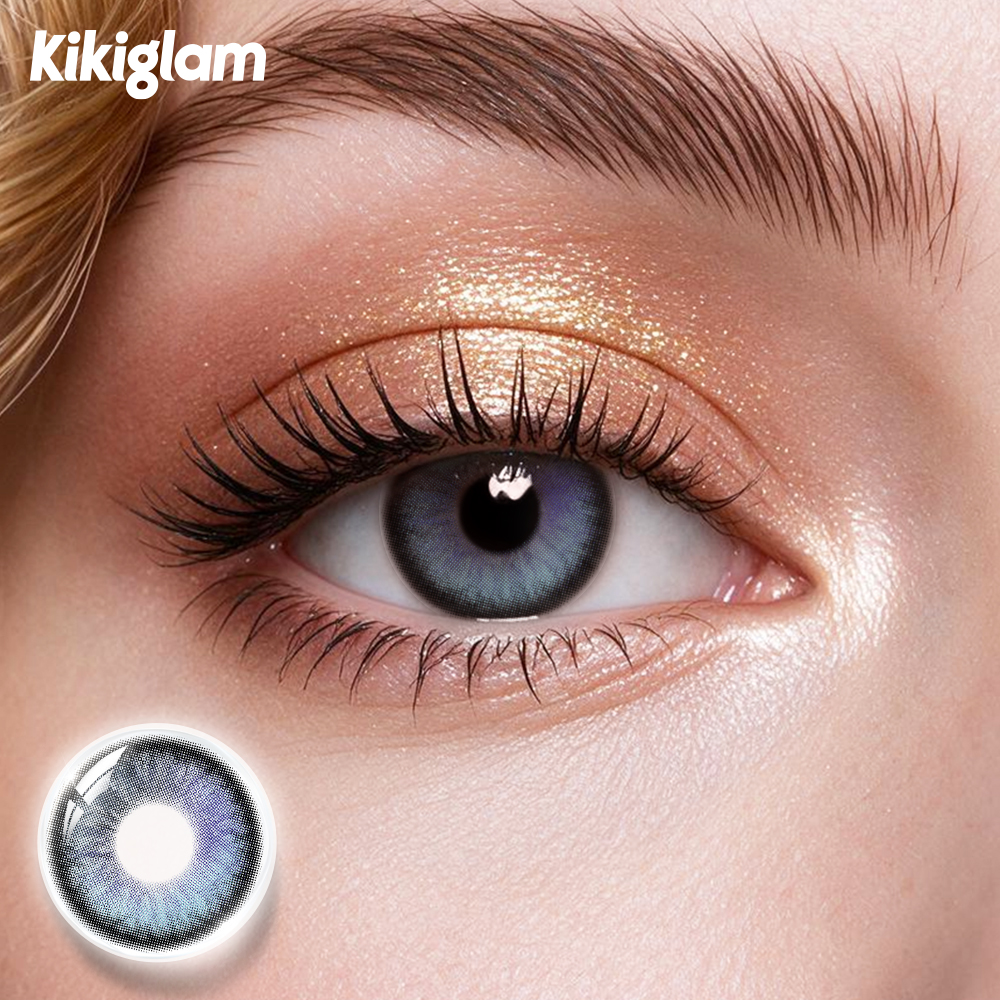
The first thing this lens changes is not "your eyes turn blue" — it is the architecture of the iris circle. In the close-up shot, the print sits as a cool blue-grey disc wrapped in a dark outer line, while the wearer's golden shimmer makeup warms everything around it. That contrast is the design's core trick: a cold ring framed by warmth reads as luminous rather than flat, because the eye keeps a glow at its edges. The 14.1mm printed area on a 14.5mm lens is deliberately wide — the dark limbal ring extends nearly to the lens edge, which is what gives the enlarge-style frame its defined boundary without swallowing the white of the eye.
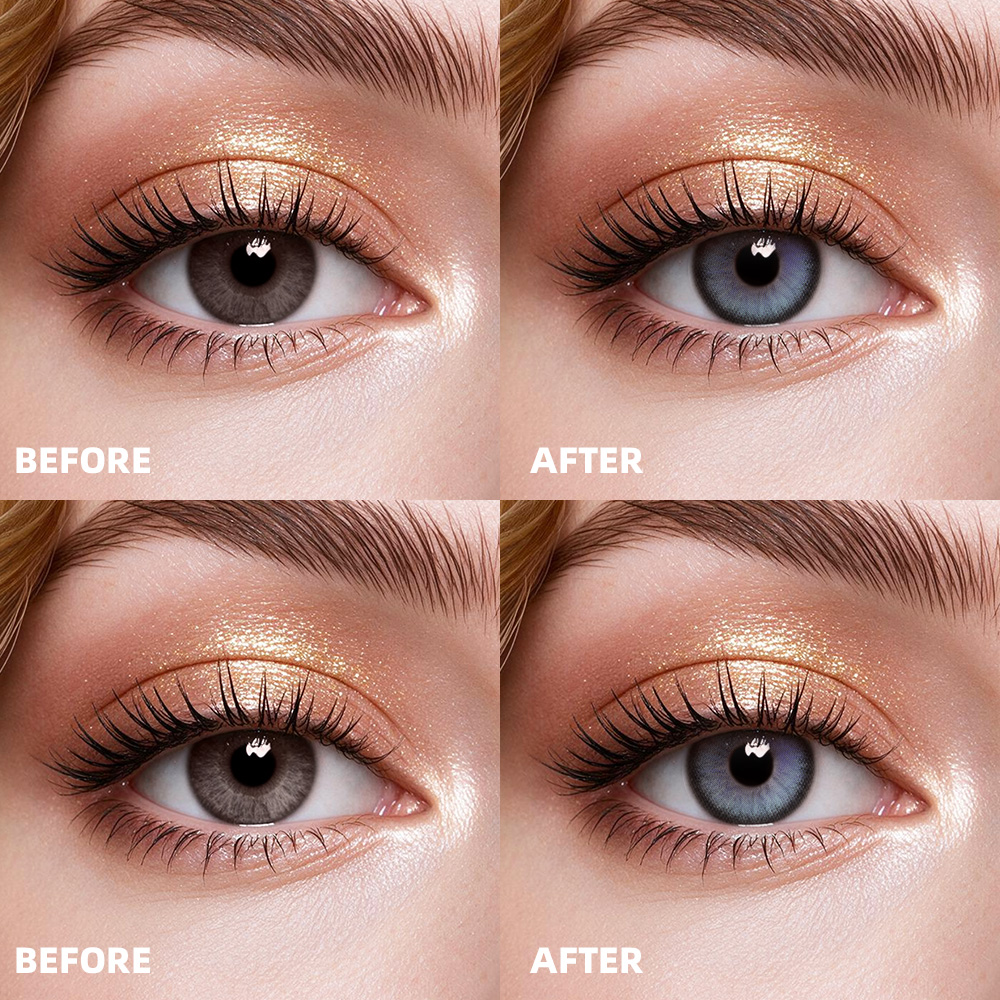
The before-and-after grid shows the shade's two anchor points. On a grey-brown iris, the transformation is short: the print cools and brightens what is already there, settling into the silver-blue of the grid's upper pair. On a deeper brown iris, the amber core inside the print matters more — the warm center merges with the eye's own pigment while the icy field covers the ring around it, so the result keeps a brown-warm heartbeat under a blue surface rather than switching the eye off entirely. Both rows keep a soft inner boundary, which is the three-tone print doing its job: no hard painted edge between the blue field and whatever sits underneath.
A dark-rimmed blue with a violet shadow ring reads theatrical on paper, but the proportions here keep it wearable. The icy field is pale enough to look like reflection rather than pigment; the dark outer line is thin enough to read as lash-line shadow instead of a costume ring. The overall signal is closer to "ethereal" than "electric" — the look of someone who might plausibly have been born near the sea. It pairs with clean skin and nude lips without demanding a full editorial face, which is why the product's own styling leans toward soft, luminous makeup rather than heavy color.
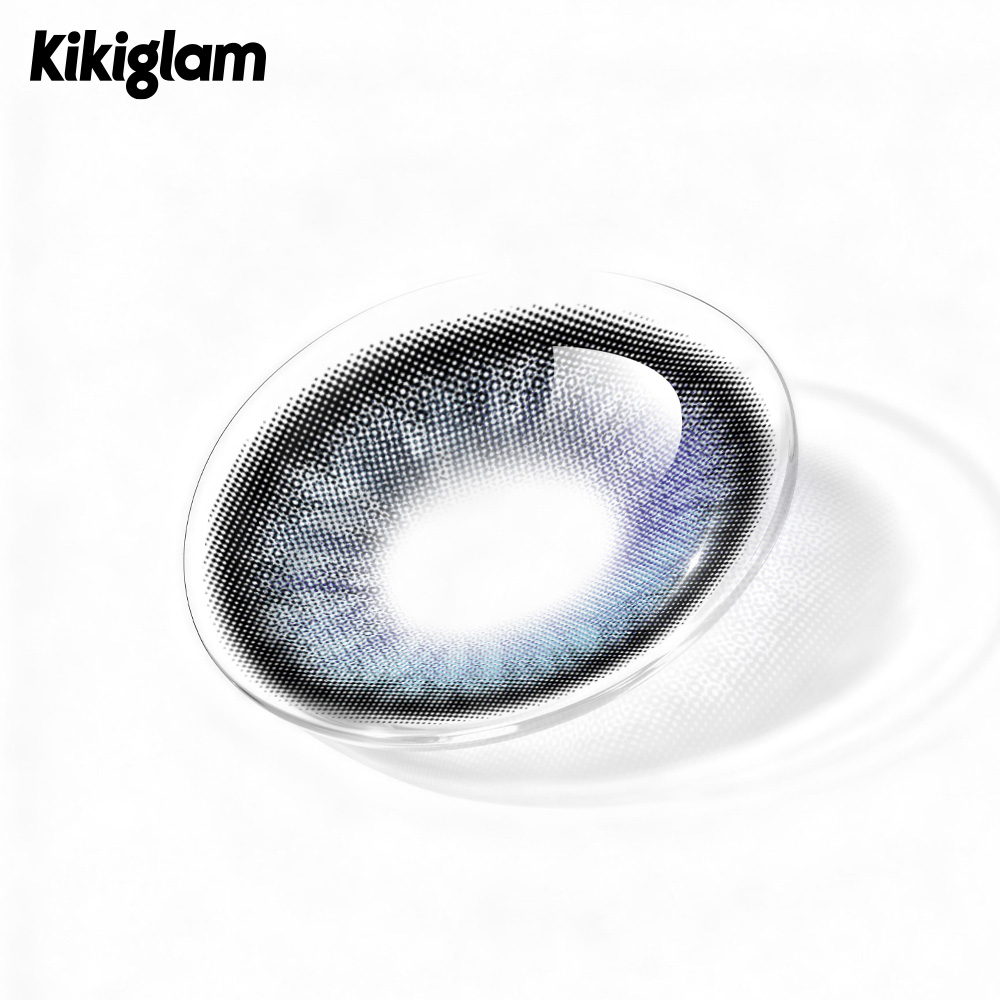
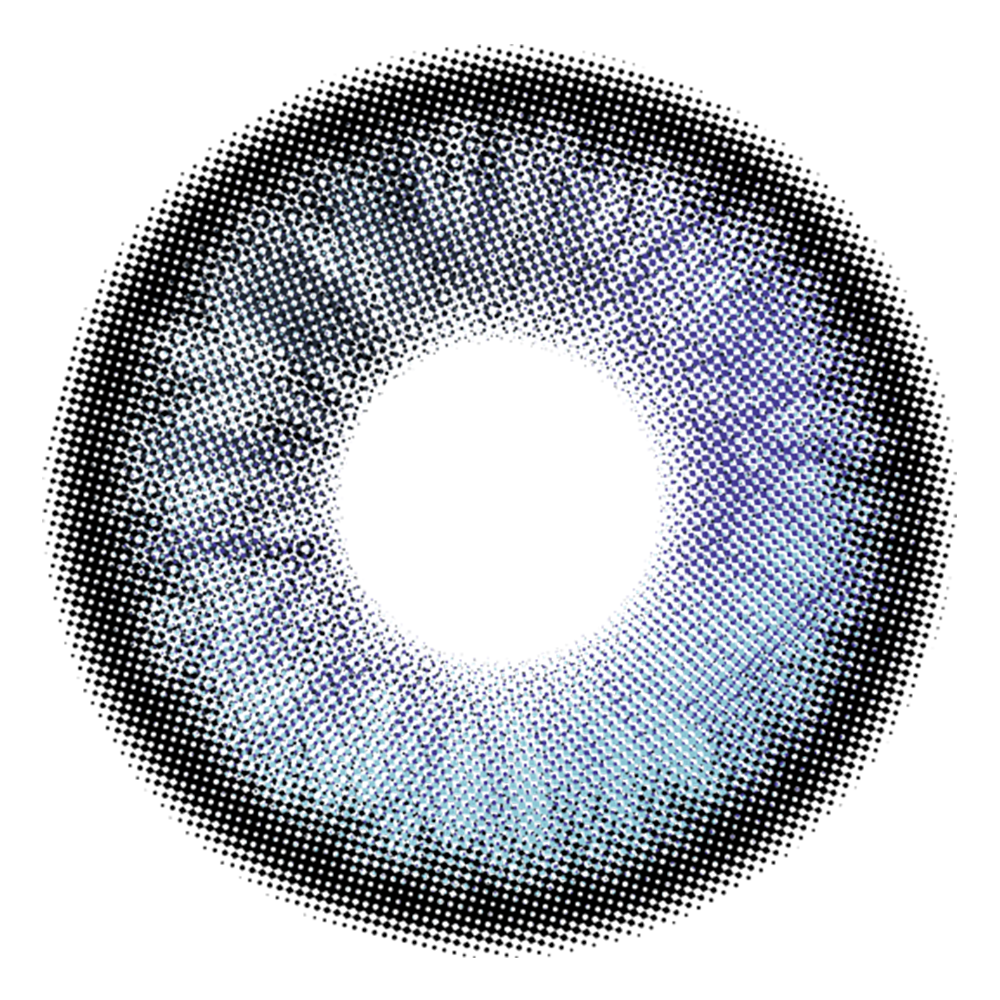
Front-on, the lens resolves into three concentric layers: a black limbal ring at the rim, a blue field shot through with violet-grey clouds, and a warm amber-brown core around the pupil window. The tilted studio shot makes the layering visible from an angle — the dark rim stays dense while the blue field shows its mottled, watery interior, exactly the irregularity that stops the print from looking like a flat colored decal.
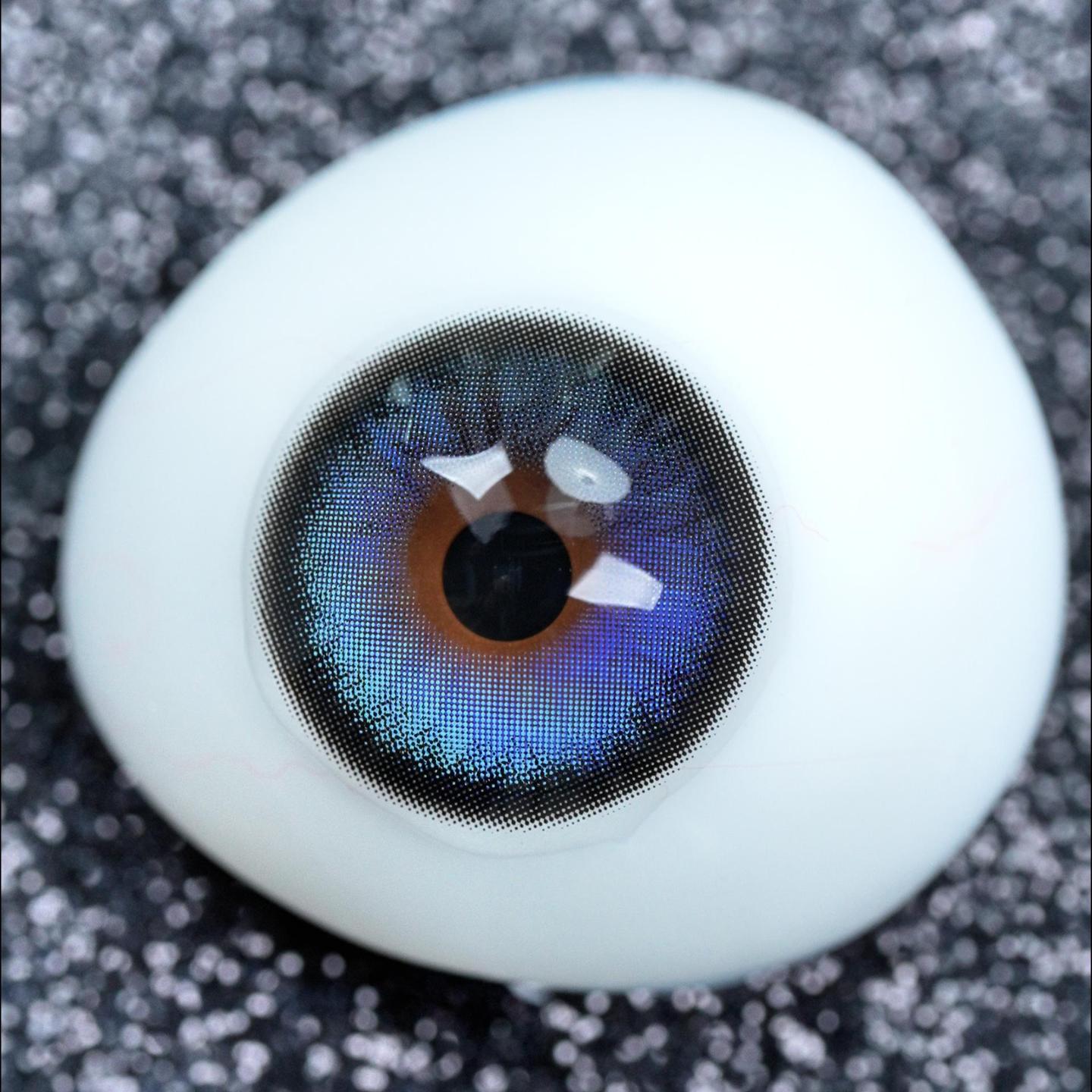
The prosthetic-eye macro explains where the warmth in the center comes from. On the white model, the black rim and blue field are unmistakable, but so is the amber ring sitting directly around the pupil — that warm core is what merges with a brown iris on dark eyes and keeps a light iris from going grey. It is the least obvious layer at arm's length and the most important one up close.
Zoomed into the flat texture shot, the print breaks into a halftone lattice: black dots packed dense at the rim, then blue and violet dots interleaving through the field with deliberate gaps, until the amber core releases the pupil entirely. The lattice's uneven density is the "water" in Nerissa — solid rings look painted, but interrupted dot fields catch light the way shallow water does. At conversation distance the print reads as one smooth blue; at inspection distance it is hundreds of dots negotiating that smoothness, which is exactly what a print built to survive a full year of wear needs.
The full-face street portrait shows the shade working at full strength: golden-hour daylight, a fair-skinned model in denim, and the blue reading clean and bright without a trace of grey murk. Outdoor light is this lens's home scene — the icy field picks up sky and reflections and turns them into sparkle around the pupil. Against deeper or golden skin tones, the same cold field produces a stronger contrast, and the design absorbs it well: the warm amber core and the model's gold jewelry are both bridges that keep the blue from detaching from the face. Cool silver makeup pushes the lens toward frost; warm bronze makeup pulls it back toward water.

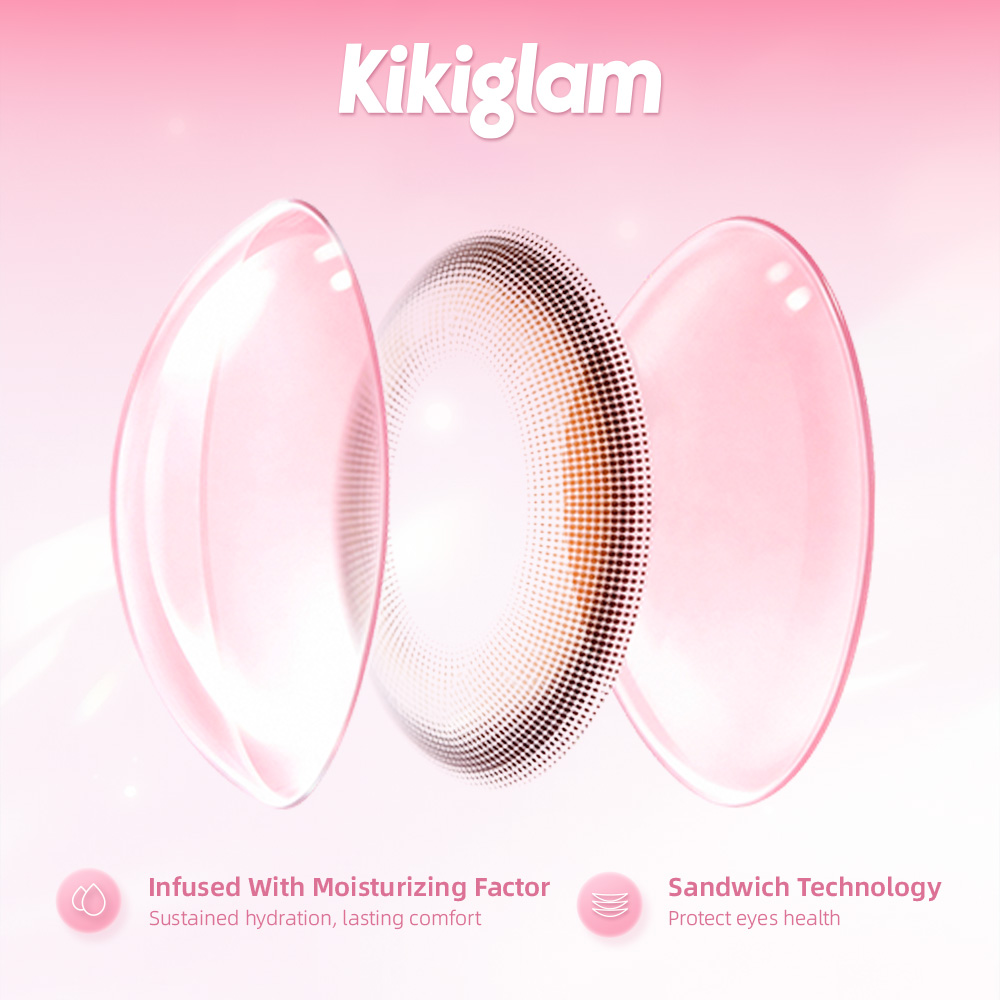
As a yearly lens, Nerissa Blue is designed to survive hundreds of wearing days, and the craft card shows the engineering behind that: the three-tone print sealed inside the lens by the sandwich method, with a moisturizing factor infused for sustained hydration through the day. The card registers 40% water content alongside the sandwich pigment structure — the color cannot fade onto your finger or into your eye because it is sealed between clear layers, and the hydration layer is what keeps a rigid 14.5mm lens comfortable past hour six. Nightly cleaning and proper case storage are the rest of the routine, and the included accessories cover that from day one.
The parameter card confirms the full registration: enlarge style, three-tone print in icy blue, violet and black, 14.5mm total diameter, 14.1mm printed diameter, 40% water content, 8.6 base curve, one-year replacement, and power from 0.00 to -8.00, listed as suitable for both light and dark eyes. The kit holds the yearly pair in sealed packaging, and Kikiglam includes a pink twin-case plus an applicator tool — the full storage and insertion set a one-year pair needs before its first night in solution.
Beyond the card, the accessories earn a line of their own. The pink Kikiglam case with its printed applicator gives the pair a dedicated home — for a lens you will keep for a full year, that case will outlive a dozen handbags.

Nerissa Blue earns its name by behaving like water rather than paint: an icy three-tone field with a violet shadow and an amber core, framed by a dark ring that defines the eye without enclosing it. On grey-brown irises it brightens; on deep brown it keeps a warm heartbeat under the blue; in daylight it sparkles and after dark it deepens. The enlarge-style 14.5mm frame, the 0.08mm-sealed sandwich print, and the $5.99 price make it a low-risk way to try a genuinely luminous blue — one that still looks like weather on water a year after you open the box.
1. Will Nerissa Blue actually show on dark brown eyes? Yes. The before-and-after grid shows a brown iris settling into a cool silver-blue, with the print's warm amber core keeping the center of the eye alive so the result never reads flat.
2. What power range is available? The card registers plano (0.00) through -8.00, so both cosmetic wearers and most nearsighted prescriptions are covered.
3. How long does one pair last? One year per pair with nightly cleaning and proper storage — this is a yearly-replacement lens, not a daily or monthly format.
4. What comes in the box? A yearly pair in sealed packaging, plus a pink Kikiglam contact lens case and an applicator tool as included accessories.
American Academy of Ophthalmology - What Are Colored Contact Lenses?
Kikiglam - 2pcs Kikiglam Nerissa Blue | 1-Year Contact Lenses
Kikiglam Blog - Marine Light Blue Contacts × Three Makeup Looks: Clean, Glam, Editorial
Kikiglam Blog - The Iris Archive: The Science Behind Every Eye Color — And How to Wear Them All
Kikiglam Blog - Reed Hazel Contacts on Brown Eyes: A Hazel That Reads Like Inherited Colour





